
Case Study: Geo-Targeted Landing Pages
That Put Your Business on the Map
Your business may serve multiple cities, counties or states. However, that reach may barely be explained on your website. For Tri-Boro, Rhino Racking Solutions and NextLevel, geographic content has been incorporated into a broader strategy connecting services, expertise and the markets being served. As a result, more useful entry points are being created for prospective customers, with measurable search visibility that is documented.
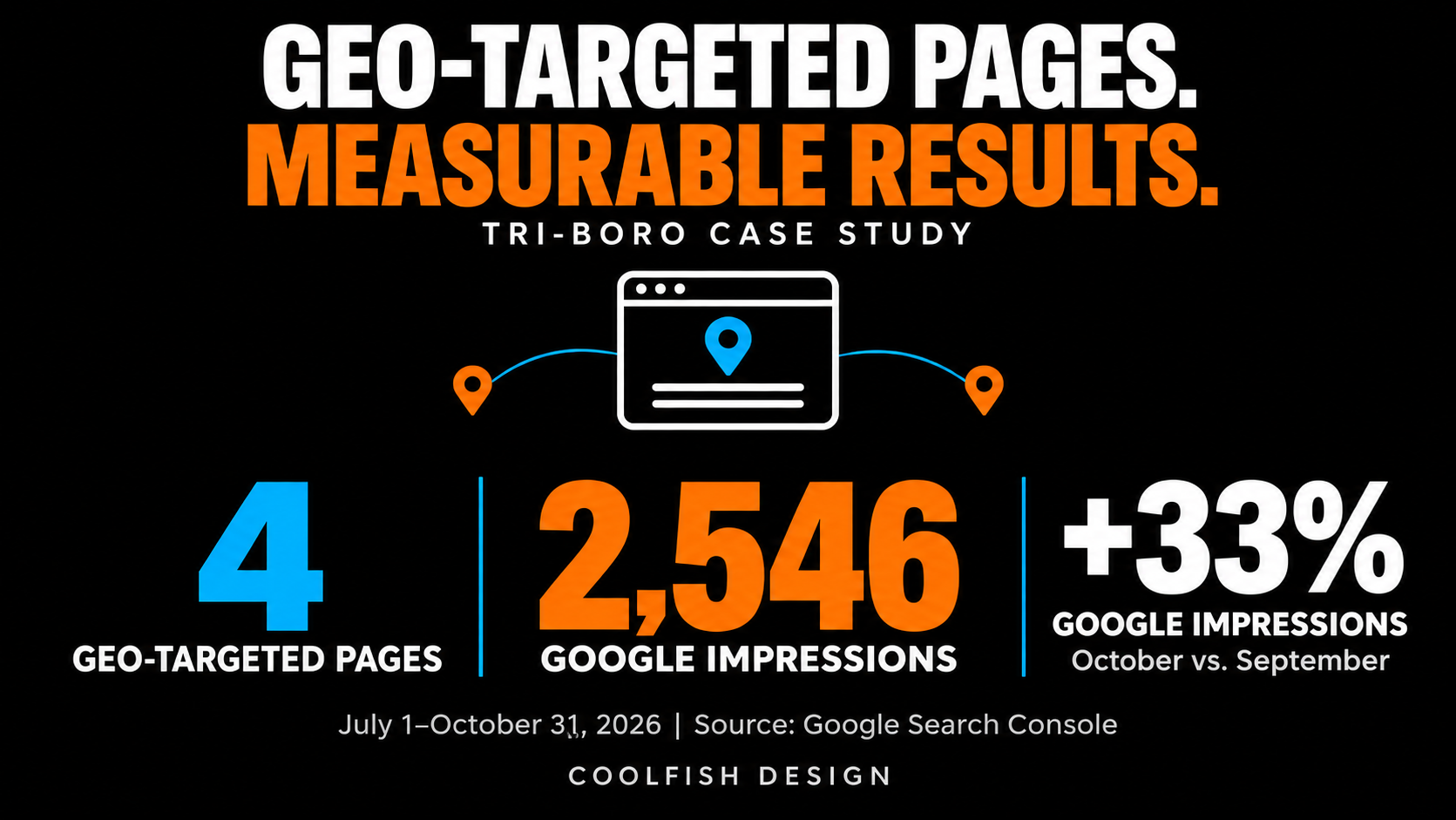
Four Tri-Boro geo-targeted pages. 2,546 Google searchs with +33% impressions in October alone.
* Click on image to view larger
The Results:
Regional Pages Are Being Found
Together, their Google impressions increased from 851 in September to 1,128 in October, approximately 33% growth.
That means these pages were appearing more often in search results, creating additional opportunities for customers to discover Tri-Boro.
Apparently, giving people a relevant page to find is more productive than hoping they land on your homepage.
AI Referrals Added Another Entry Point
During the same July through October period, Tri-Boro’s website recorded 95 AI-attributed visits: 89 from ChatGPT and six from Gemini.
Monthly AI-attributed visits increased from 18 in July to 33 in October.
These are website-wide referrals, reported separately from the four landing pages. They show another way visitors reached the business, rather than proving that any one location page caused an AI recommendation.
Source: Google Search Console and GA4. Impressions and clicks cover the four pages across all searcher locations. Page views include repeat views. AI-attributed visits are recorded website sessions.
Beyond Tri-Boro: The Same Strategic Connection
Rhino Racking Solutions has reported business opportunities from Orlando and Lakeland, both markets addressed through geo-targeted pages.
Those opportunities provide a useful business signal alongside traffic reports. They do not establish that every inquiry originated from a particular page, but they support continued investment in content for markets Rhino actively serves.
For NextLevel, geographic content forms part of a larger strategy covering mezzanines, luxury garages, car condos and related technical subjects.
The purpose is to connect what the company knows, what it provides and where it works. Geographic pages support that broader structure rather than carrying the entire search strategy themselves.
Different businesses. Different markets. The same need to explain the connection.
Give Every Location Page a Reason to Exist
Changing the City Name Is Not a Content Strategy. Shocking, We Know. 😆
A useful geo-targeted landing page answers a practical question:
Can this company help someone like me, with this need, in this location?
Our approach brings together:
- Relevant services: What customers in the target market can actually purchase or request.
- Useful geographic context: Where the business works and how that service area is supported.
- Evidence and expertise: Relevant capabilities, project examples and customer questions.
- Connected content: Links to service pages and supporting resources.
- A clear next step: An easy way to discuss a project or request information.
The goal is a page that helps someone make a decision. The location belongs in the explanation because it matters to the customer.
Our CAT™ Framework is built around three things:
A City Name Is Not a Credential.
Our CAT™ Framework connects three essential parts of the story:
Credibility: Show that the business has the capabilities to do the work.
Authority: Connect geographic content with deeper service and subject expertise.
Trust: Explain service coverage honestly and make the next step clear.
Together, these elements give visitors useful information while making the relationships among services, subjects and locations easier to understand.
We Connect the Dots. More Relevant Entry Points. A Clearer Business Story.
Geo-targeted landing pages can help your business:
- Reach people searching for services in markets you actually serve.
- Answer location-specific questions before someone contacts you.
- Connect regional demand with the right services and expertise.
- Build useful content that can be measured and improved over time.
Tri-Boro’s results show measurable visibility for four geographic pages. Rhino’s reported opportunities add a business perspective. NextLevel demonstrates how geography fits within a broader authority strategy.
Your service area deserves more than a sentence buried above the copyright notice.
I’d be happy to review how your website represents the markets you serve and identify where useful geographic content could strengthen your search strategy.

tel:813-785-5337
Coolfish Design & Marketing
Tampa-based. Helping businesses earn credibility, authority, and trust online.
Frequently Asked Questions
Because “Just Add More Cities” Is Still Not Much of a Plan. 😉
Geo-targeted landing pages explain a business’s services for a specific city, region or service area. A useful page connects the location with relevant capabilities, customer questions and a clear way to take the next step.
A service page explains what you offer. A geo-targeted page adds relevant context about where that service is available. The pages should complement each other and help visitors find the information they need.
No. Markets are selected based on actual service coverage, business priorities and whether a useful, distinct page can be created. Publishing dozens of nearly identical pages is not our idea of a productive afternoon.
They can provide useful context about services and locations. However, inclusion in AI answers is not guaranteed. We evaluate recorded AI referrals separately from page-level search performance so the results remain clear.
We review page-level Google impressions and clicks, website engagement and available inquiry data. Regional traffic and recorded AI referrals provide additional context. When lead tracking is available, inquiries can be assessed more directly.
No. Geo-targeting refers to geographic markets. GEO, or generative engine optimization, concerns visibility in AI-generated answers. They can support the same broader marketing strategy, but they describe different things.
Reach the Right Markets. Get Found. Get Chosen. WGSD.
Analytical Website Design • Creative Marketing • SEO Certified • Tampa, Florida 33615 • Working With Businesses Nationwide. • Ph: 813.785.5337 • Em: chet@coolfishdesign.com
* WGSD: We Get Sh*t Done