
The Modern Marketing Journey
Advertising Gets Their Attention. Google and AI Help Them Decide.
Because Apparently Saying You’re Amazing in an Ad Is No Longer Enough. 😉
People often think their website is their marketing.
It is not.
A website is only one part of a much larger journey. A potential customer may first discover a business through advertising, social media, an email campaign, a referral, direct mail, or a billboard. However, before a decision is made, the business will usually be researched.
Google will be searched. Reviews will be read. AI platforms may be asked for recommendations.
Competitors will be compared. Finally, the website will be visited.
Therefore, every part of the journey must be built to work together. Otherwise, the advertising may create attention while the digital foundation quietly loses the customer.
Your Advertisement Is Only the Beginning
The Customer Journey Does Not End When Someone Sees Your Ad.
That Is Where It Starts.
A successful advertisement creates awareness and curiosity.
Someone sees the business. The name is remembered. A problem may suddenly feel solvable.
However, most people do not immediately call, schedule, or purchase. Instead, the next step is taken privately. The business is searched, investigated, and compared.
In other words, the ad opened the door.
It did not close the sale.
Customers rarely see a billboard and immediately yell,
“Take my money!”
Advertising creates awareness.
Google and AI create confidence.
Your website turns confidence into action.
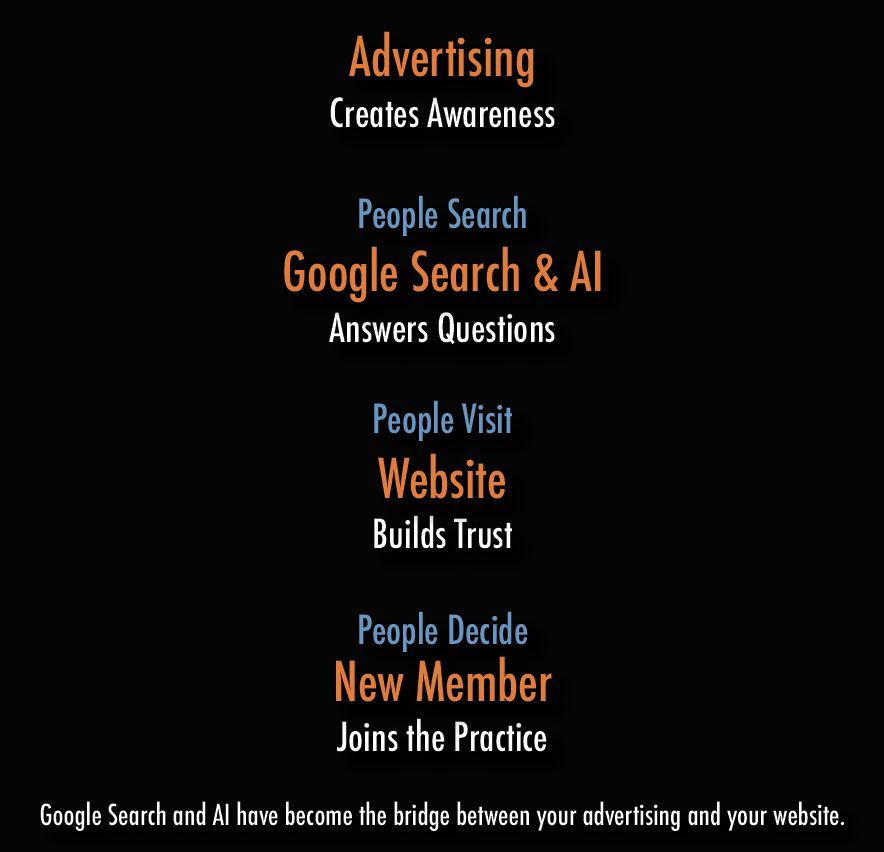
How People Actually Choose a Business Today
The Modern Marketing Journey Is Built Around
Four Connected Stages.
Modern marketing is not a collection of disconnected services.
Advertising, search, AI, reviews, content, and websites all influence the same decision. Each stage either strengthens confidence or gives the potential customer a reason to keep looking.
That is why a business can run a successful advertising campaign and still produce disappointing results.
The advertisement may be working perfectly.
Everything that happens afterward may not be.
Awareness
A business is discovered through advertising, social media, direct mail, email, referrals, sponsorships, signage, or other promotional activity.
The goal: Get noticed.
Research
The business is searched on Google, reviewed through multiple platforms, compared against competitors, and increasingly evaluated by AI-generated answers.
The goal: Be found and understood.
Confidence
Reviews, content, case studies, photos, videos, credentials, FAQs, and website quality work together to establish credibility.
The goal: Earn trust.
Decision
The customer calls, schedules, visits, submits a form, or makes a purchase because the entire journey created enough confidence to act.
The goal: Convert attention into business.
The Sale Did Not Happen Because of One Advertisement.
It Happened Because Every Step Supported the Next One.
Google and AI Have Become the Bridge
Most businesses invest in advertising.
Many invest in a website.
However, the connection between those two is often overlooked.
That connection is now heavily influenced by Google Search, Google Business Profiles, online reviews, AI Overviews, ChatGPT, Google Gemini, and other AI-powered discovery platforms.
Before a website is visited, the business may already have been judged.
Its reputation has been reviewed. Its expertise has been evaluated. Its information has been compared. In some cases, an AI platform has already decided whether the business deserves to be mentioned at all.
Your Website Is Not Always the First Impression
Search results often appear before the website.
Reviews often appear before the website.
Business listings often appear before the website.
AI summaries may describe the business before the website is ever opened.
Therefore, the website cannot be treated as an isolated marketing piece. It must support the same message, expertise, and trust signals found throughout the rest of the digital presence.
Your website may be beautiful.
Unfortunately, it cannot impress someone who never reaches it.
Where Marketing Campaigns Quietly Fall Apart
Attention Was Purchased. Confidence Was Never Built.
Businesses often spend significant money creating awareness while very little attention is given to what the customer finds next.
The search results may be inconsistent.
The website may be outdated.
The content may be thin.
The reviews may be ignored.
The business may be difficult for AI platforms to understand.
When this happens, advertising does not necessarily fail. Instead, the digital foundation fails to support it.
That distinction matters.
A campaign cannot be accurately judged by clicks, impressions, or visibility alone. The entire customer journey must be considered.
The advertisement did its job. The online presence did not.
This Is Why We Built
Credibility
Can the business be verified?
Accurate information, legitimate experience, consistent branding, reviews, credentials, and a professional online presence help establish that the business is real and dependable.
Authority
Has expertise been clearly demonstrated?
Strong service pages, educational content, case studies, topical depth, internal linking, and original insight help establish industry authority.
Trust
Does the business feel like the right choice?
Reviews, transparency, useful information, clear communication, proof of experience, and website quality all influence customer confidence.
These signals are not built through one page, one advertisement, or one clever social media post.
They are built through a connected strategy.That is precisely what the CAT Framework was created to support.
Every Page Must Support the Journey
A website should not simply provide a homepage, an about page, and a contact form.
Each page should answer a specific question, demonstrate expertise, reinforce the business identity, and provide search engines and AI systems with useful context.
Service pages, location pages, articles, case studies, FAQs, images, videos, reviews, and structured data should all be designed as parts of the same system.
When those elements are connected properly, the website becomes more than an online brochure.
It becomes evidence.
Structure Helps Google and AI Understand the Business
Search platforms do not interpret a business based solely on appearance.
They rely on structure, consistency, context, relationships, and supporting signals.
Clear headings, internal links, schema markup, topical coverage, business information, FAQs, and useful content all help explain:
- who the business is
- what it does
- where it operates
- what it knows
- why it may deserve to be recommended
For the page layout, place those five items in a single inline sentence or icon strip, not five separate vertical bullet lines:
Identity • Services • Location • Expertise • Recommendation
Google and AI cannot “just know what you meant.” They are powerful, but they are not your mother.
SEO cannot be separated from website design.
Website design cannot be separated from content.
Content cannot be separated from authority.
Authority cannot be separated from trust.
Advertising cannot be separated from what happens after someone becomes interested.
When these areas are managed independently, gaps are created. When they are connected, each investment helps strengthen the others.
That is the difference between simply running marketing activities and building a marketing system.
For the visual layout, I would show this as a centered horizontal connection:
Advertising → Search & AI → Website → Trust → Action
No enormous list. No thirty-foot page. Just the journey.
Google and AI cannot “just know what you meant.” They are powerful, but they are not your mother.
Getting Attention Is Great. Knowing What Happens Next Is Generally Helpful.
At Coolfish Design, websites, SEO, AI visibility, content, schema, internal linking, and marketing campaigns are not treated as separate projects living on separate islands.
They are built to support the same journey.
That means the goal is not simply to create a website or generate more traffic. The goal is to make sure a potential customer can discover the business, understand its value, trust its expertise, and confidently take the next step.
Better Visibility
The business is positioned to be discovered through traditional search and evolving AI-powered platforms.
Stronger Authority
Content and website structure are used to demonstrate real expertise instead of simply making claims.
Greater Trust
Reviews, proof, consistency, and useful information help potential customers feel more confident.
More Value Advertising
Every advertising campaign is supported by a stronger digital foundation after the customer becomes interested.
Want to Know Where Your Marketing Journey Breaks Down?
Request a Modern Marketing Review
Coolfish Design does not build websites in isolation. We study how people discover businesses, how Google interprets information, how AI systems evaluate content, and how customers move from curiosity to confidence.

tel:813-785-5337
Coolfish Design & Marketing
Tampa-based. Focused on results. Built to perform.
Frequently Asked Questions About the Modern Marketing Journey
Modern marketing rarely moves in a straight line. A customer may discover a business through advertising, research it through Google or AI, compare reviews, visit the website, and only then decide what to do next. These questions explain how each step works together and why missing one can weaken the entire journey.
The modern marketing journey describes the steps someone takes from first discovering a business to becoming a customer. It often includes advertising, Google Search, AI research, reviews, website visits, competitor comparisons, and a final decision.
Yes. Advertising remains extremely valuable for creating awareness and introducing a business to potential customers. However, advertising usually starts the customer journey rather than completing it.
Customers often want to verify a business before making contact. They may search for reviews, services, experience, credentials, pricing information, photos, case studies, and evidence that the business can be trusted.
Google and AI platforms increasingly influence which businesses are discovered, understood, compared, and recommended. A business must be structured clearly enough for both search engines and AI systems to interpret its expertise and relevance.
Yes. A website remains one of the most important places for building confidence and converting interest into action. However, it must work together with search visibility, reviews, content, AI visibility, and the broader online presence.
Yes. Someone may see an advertisement and become interested, but weak search results, inconsistent information, poor reviews, or an outdated website can reduce confidence before the customer takes action.
The CAT Framework is Coolfish Design’s approach to strengthening Credibility, Authority, and Trust. These three areas help businesses become more understandable, discoverable, and persuasive across Google, AI platforms, and the customer journey.
Topical authority is built when a business demonstrates meaningful depth and expertise around the subjects it serves. It is developed through connected service pages, educational content, case studies, FAQs, internal linking, and consistent business information.
Schema markup provides structured information that helps search engines and AI systems interpret a page, business, service, article, or FAQ more accurately. It does not replace quality content, but it helps explain that content more clearly.
A visitor may enter a website through any page, not only the homepage. Therefore, each page should clearly explain the topic, establish relevance, answer questions, reinforce trust, and provide an appropriate next step.
Coolfish Design develops connected strategies that combine website architecture, SEO, AI visibility, content, schema, internal linking, authority development, and marketing campaigns. Each component is designed to support the same customer journey.
Analytical Website Design • Creative Marketing • SEO Certified • Tampa, Florida 33615 • Working With Businesses Nationwide. • Ph: 813.785.5337 • Em: chet@coolfishdesign.com